A headache diary for the days you can barely look at a screen.
Log an attack in two taps. See how many headache days you really had, what you took, and whether it helped. Walk into your neurology appointment with one page that says it all — instead of trying to remember six months at once.
The appointment is ten minutes. The six months before it are what matter.
A neurologist asks how many days you had pain last month, what you took, whether anything helped — and for anyone with a daily or near-daily headache, the honest answer is that it all runs together. Those answers decide whether you meet criteria for chronic migraine, whether medication overuse is part of the picture, and whether a preventive is worth continuing.
I live with New Daily Persistent Headache, and I built this app because I kept arriving at appointments with a story I could not evidence. It is designed around the questions a headache specialist actually asks, and it is useful whether you live with migraine, tension-type headache, NDPH, or a headache nobody has named yet.
Five screens, one clear record.
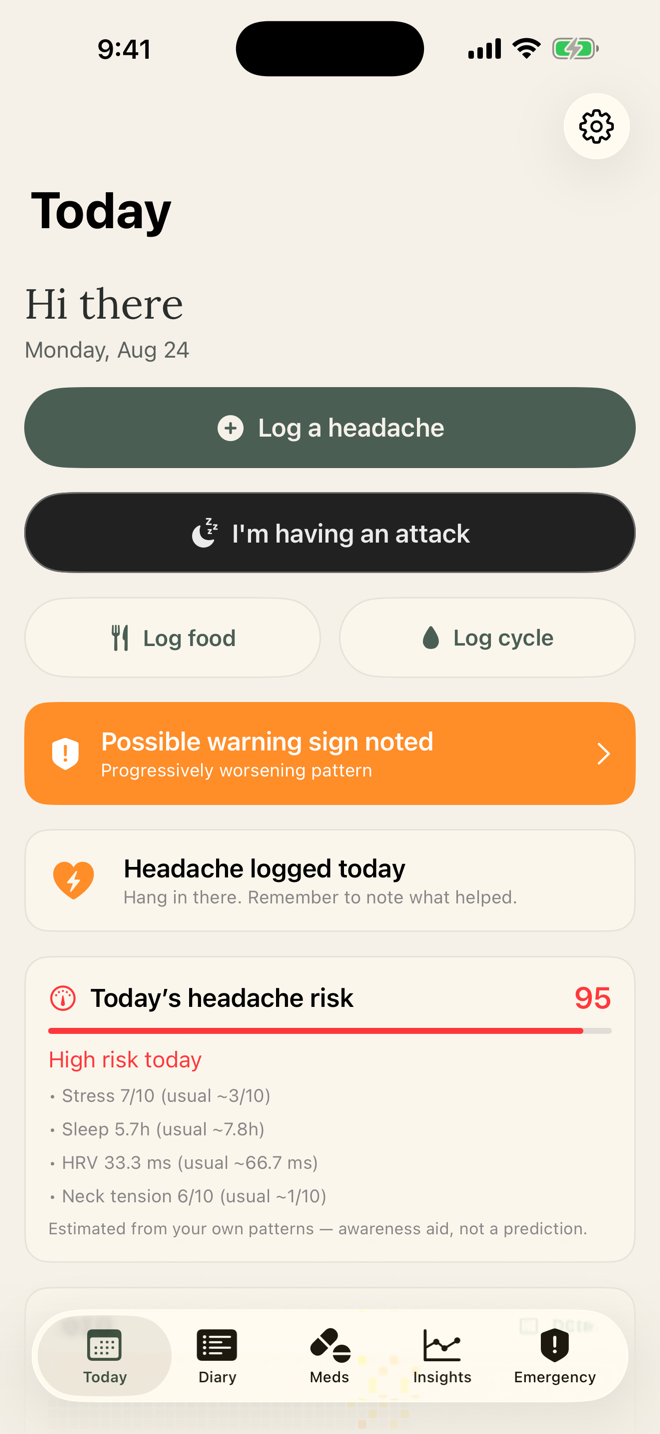
Today: log it now, detail it later.
“I’m having an attack” opens a dimmed, high-contrast screen with no animation, so you can record an episode in two taps when light hurts. Siri can log one hands-free.
- Food and menstrual-cycle logging alongside headaches
- A daily risk estimate from your own patterns — stress, sleep, HRV, neck tension
- A plain-language notice when something you logged matches a warning sign
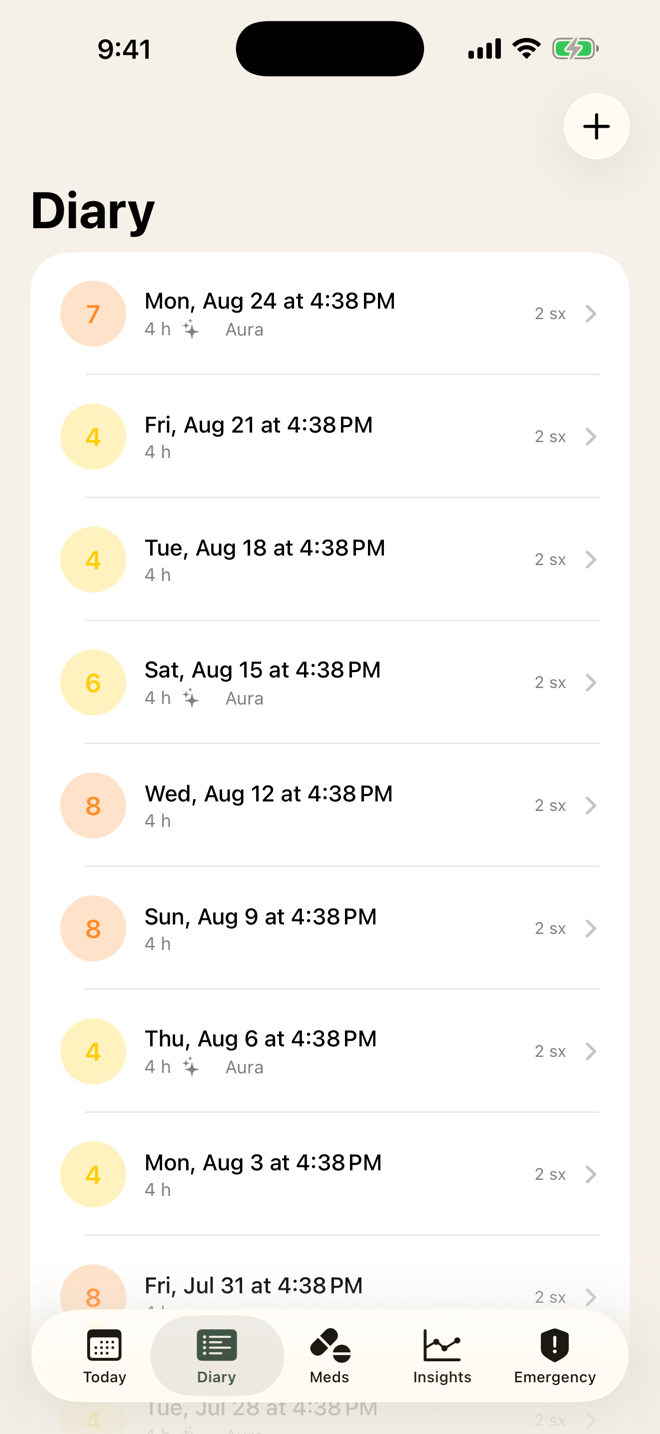
Diary: every episode, at a glance.
Each headache is listed with its date, severity, duration, symptoms and aura, colour-coded so bad stretches stand out. Tap any entry to add location, quality, triggers or what helped.
- Severity on a 0–10 scale
- Aura and associated symptoms
- Edit or add detail whenever you’re able to
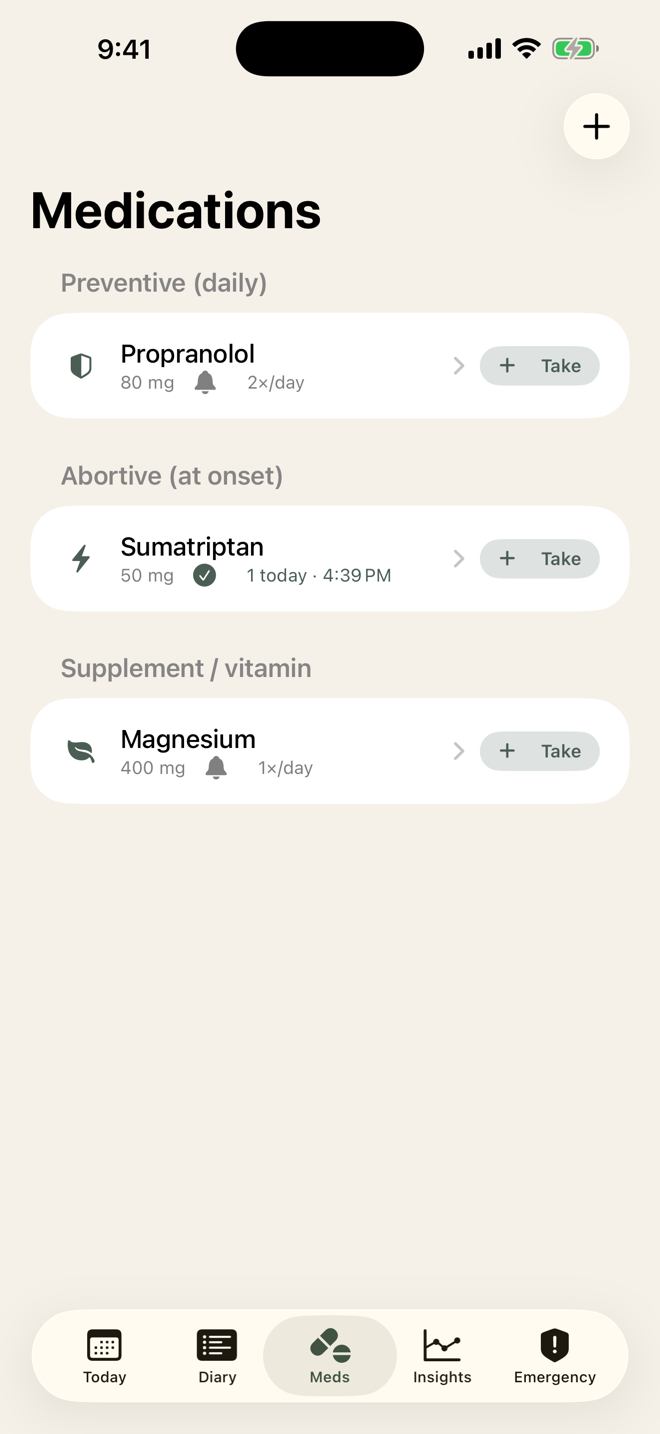
Medications: overuse, counted properly.
Preventives, acute (abortive) medications and supplements, each with a dose, reminder and one-tap “Take”. Days of use are counted against the published monthly limit for each drug class, so medication-overuse headache doesn’t sneak up on you.
- 10 days/month for triptans, ergots, opioids and combination analgesics
- 15 days/month for simple analgesics and NSAIDs
- Reminders for daily preventives
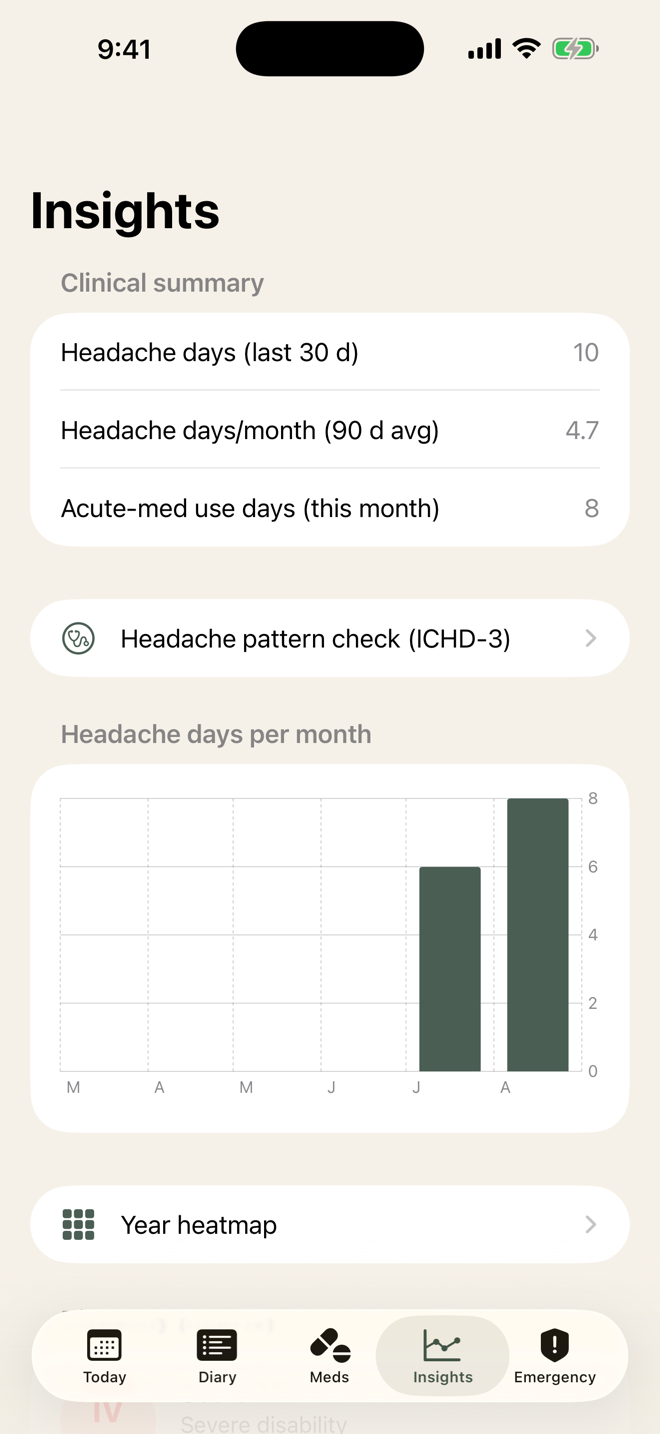
Insights: the numbers your neurologist asks for.
A clinical summary of headache days and acute-medication days, a month-by-month chart and a year heatmap. See which factors differ between your headache days and clear days, and whether a preventive actually changed anything after you started it.
- Headache pattern check against ICHD-3 criteria
- MIDAS disability score
- One-page PDF report and CSV export for any period
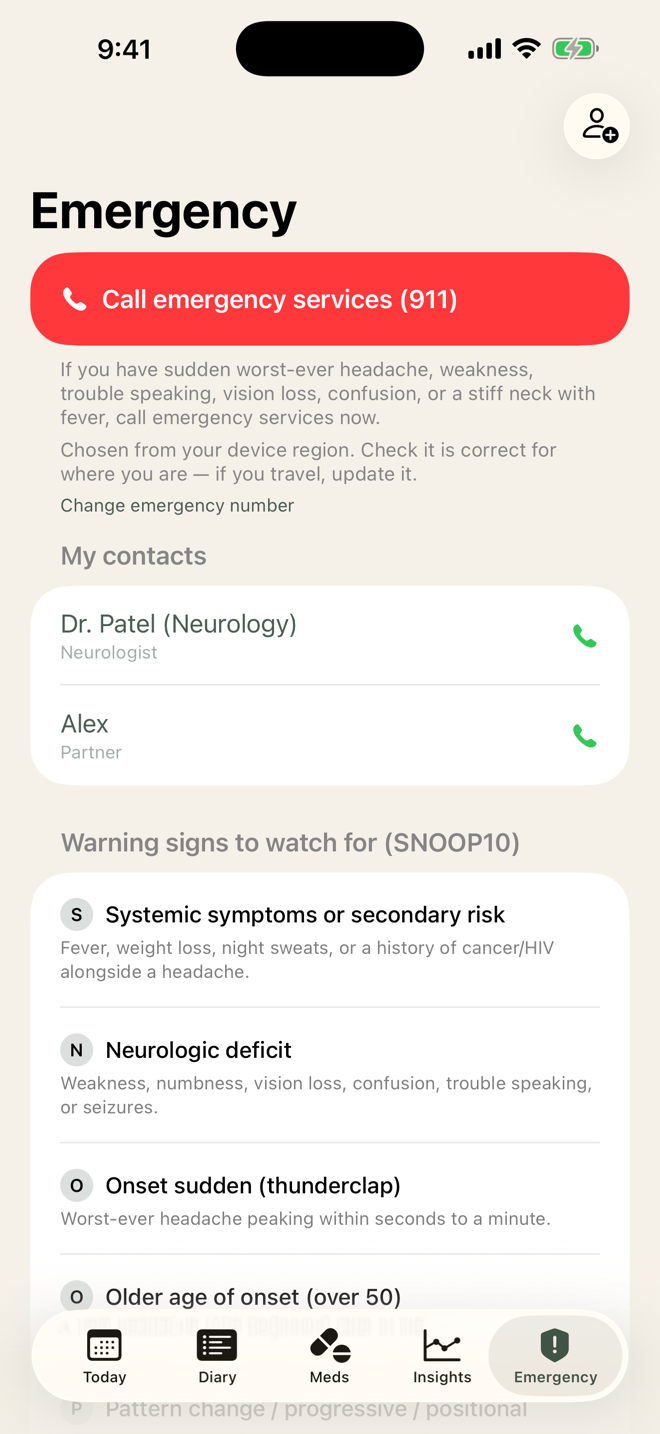
Emergency: when it’s not the usual headache.
One tap calls your local emergency number, chosen from your device region. Your neurologist and the people you trust are a tap away too, and every SNOOP10 warning sign is explained in plain language, so you know which changes mean “get seen today”.
- Emergency number set from your region, easy to change when you travel
- Quick-dial contacts for your clinician and family
- SNOOP10 red flags, from thunderclap onset to a changing pattern
Built on the same criteria specialists use.
Built for bad days
A dimmed, high-contrast attack screen logs an episode in two taps. Siri can log one hands-free. Add the detail later.
One page for your neurologist
A PDF with your headache-day trend, a pattern heatmap, medications with overuse flags, possible triggers and your latest MIDAS score. Raw CSV too.
Medication-overuse thresholds
Days of use counted per drug class against published monthly limits, with a clear flag before you cross them.
Warning signs, by the book
What you log is screened against the SNOOP10 red flags taught in neurology — prompts to seek care sooner, never a verdict.
Patterns, not guesses
Which factors separate headache days from clear days, whether a preventive helped, and how your features line up with ICHD-3.
Your diary stays yours
No account and no server. Everything lives on your iPhone or in your own private iCloud. No analytics, no advertising, no tracking.
- Price
- Free. No ads, no subscription, no account.
- Requires
- iPhone with iOS 17 or later
- Languages
- English, Portuguese, Spanish
- Data
- Stored on your device, with optional private iCloud sync. Nothing is sent to a server. Privacy policy
- Developer
- Seth Mundall, MD — physician and software engineer, living with NDPH
- Support
- Support page · seth@ndph.org
Frequently asked.
Is Migraine & Headache Companion free?
Yes. The app is free on the App Store, with no account to create and no advertising.
Does the app diagnose headaches?
No. It records what you tell it, shows you the shape of your own data, and compares your logged features with published criteria such as ICHD-3 and SNOOP10. Those comparisons are prompts to discuss with a clinician, never a diagnosis.
Where is my headache data stored?
On your iPhone, or in your own private iCloud if you turn syncing on. There is no account and no server, and the app contains no analytics or tracking.
Is it useful for New Daily Persistent Headache (NDPH)?
Yes — it was built by a physician who lives with NDPH. The headache-day counts, medication-overuse tracking and clinician report are designed for exactly the kind of history a neurologist asks about. For more on the condition itself, see the NDPH guide.
Which devices and languages are supported?
iPhone running iOS 17 or later. The app is available in English, Portuguese and Spanish.
Stop trying to remember. Start keeping the record.
Free on the App Store for iPhone.
Download on the App Store