New Migraine & Headache Companion is now on the App Store — a free headache diary for iPhone.
Free Not sure which kind of headache you have? Answer a few questions and find out.
A guide for those living with NDPH

The headache that never went away.

New Daily Persistent Headache is rare, real, and often invisible to everyone but the person living with it. This page is a careful, evidence-based starting point — not a cure, but a companion.

You remember the day it started. You are not imagining it. You are not alone in it. There is no single fix, but there are many paths worth trying — and most people who improve do so by stacking small wins.

A headache with a start date.

New Daily Persistent Headache (NDPH) is a primary headache disorder defined by one strange, specific feature: people with NDPH can usually name the exact day, often the exact hour, the headache began — and it has not stopped since.5

Unlike migraine, where headaches come in attacks with periods of relief, NDPH is continuous from onset. To meet diagnostic criteria, the headache must be daily, unremitting, and present for at least three months, with a clearly remembered beginning.1 Most people with NDPH had no significant headache history before that day.

It’s rare — estimated to affect 0.03% to 0.1% of the general population.2,3 It tends to begin after a clear precipitating event in roughly half of cases: a viral infection (Epstein-Barr virus, the flu, COVID-19), a surgery, an injury, or a major life stressor. In the other half, it appears without any identifiable trigger.4,5

Researchers now believe NDPH is not one condition but a syndrome with multiple underlying mechanisms — neuroinflammation, persistent immune activation, cervical spine involvement, and changes in pain processing pathways have all been implicated. This is why no single treatment works for everyone.7

0.03%
Estimated population prevalence
~50%
Begin after a viral illness or stressor
3+
Months minimum for diagnosis
1day
Often remembered with exact precision

What sets it off?

Roughly half of NDPH cases follow a recognizable triggering event. Identifying yours can help guide treatment, since different origins often respond to different approaches.

Viral Infection

The most commonly identified trigger.4 In one study, 84% of 32 patients with NDPH showed signs of active Epstein-Barr virus (mononucleosis) infection, compared with 25% of controls.6 COVID-19, herpes simplex, cytomegalovirus and influenza have also been linked.7

Surgery or Intubation

Cases following general anesthesia or intubation suggest mechanical stress on the upper cervical spine and dura mater may play a role in some patients.4

Major Stress or Trauma

Bereavement, divorce, accidents, or sustained periods of high stress can precipitate NDPH. The immune and inflammatory effects of chronic stress likely interact with vulnerable pain pathways.4

Cervical Spine Injury

Whiplash, falls, and other neck trauma can produce NDPH-like presentations. This subset may respond particularly well to physical therapy and nerve blocks.9

Thunderclap Onset

A small subgroup describes the headache beginning with a sudden, severe “worst headache of my life” episode. This subtype may involve cerebral artery vasospasm and sometimes responds to calcium channel blockers like nimodipine.8

No Identifiable Cause

For roughly half of patients, no clear precipitating event can be found. This is not unusual and does not change the diagnosis.4 Many treatment approaches still apply.

Four pillars of self-care while you find what works.

There is no cure for NDPH, and even aggressive medical treatment fails many patients. But studies consistently show that people who actively manage their general health respond better to the treatments their doctors do offer. Build the foundation. Then layer specific tools on top.

PILLAR ONE

Reduce inflammation in the body

NDPH appears to involve neuroinflammation. The diet you eat, the omega-3s and vitamin D in your bloodstream, and the diversity of your gut bacteria all influence systemic inflammation — the background level your nervous system is asked to handle every day.

PILLAR TWO

Stabilize the cervical spine

The upper neck is densely connected to head pain pathways. Forward head posture, weak deep neck flexors, and tight suboccipital muscles can amplify or perpetuate any chronic headache. Daily gentle stretches and posture work cost nothing and may help significantly.

PILLAR THREE

Train the pain response

Chronic pain rewires the nervous system over time, amplifying ordinary signals. Mindfulness, biofeedback, and cognitive-behavioral approaches don’t make pain disappear — but they consistently reduce its grip on daily life.

PILLAR FOUR

Work with the right specialist

NDPH is often misdiagnosed as chronic migraine or tension-type headache. A headache specialist (neurologist with subspecialty training in headache medicine) is far more likely to recognize NDPH subtypes and offer treatments matched to the underlying mechanism.

Supplements with the strongest evidence.

These are drawn from the headache and migraine prevention literature — specific NDPH studies are scarce, but most headache specialists apply this evidence to NDPH given the overlap in mechanisms.

Before you start anything. Talk to your doctor or pharmacist, especially if you take prescription medications or have a chronic condition. Supplements interact with drugs — sometimes seriously. Start one at a time, several weeks apart, so you can tell what helps. Keep a brief headache diary to track changes.

Magnesium

A foundational mineral
Strong evidence for headache

What it does

Given a strong recommendation for migraine prevention by the Canadian Headache Society guideline.10 Many people with chronic headache disorders run low in magnesium. It plays a role in nerve excitability, blood vessel regulation, and the calming of overactive pain pathways.

Dose & form

400–600 mg of elemental magnesium daily. Magnesium citrate is the form the Canadian guideline names; magnesium glycinate is gentlest on the stomach. Magnesium oxide is also widely used in studies but causes loose stools more often. Build up slowly over a week or two.

What to know

  • Effects often take 6–8 weeks to appear
  • If you get diarrhea, lower the dose or switch form
  • People with kidney disease should consult a doctor

Riboflavin (B2)

Vitamin B2, mitochondrial cofactor
Strong evidence for headache

What it does

Riboflavin supports mitochondrial energy production. Some imaging studies suggest mitochondrial dysfunction in chronic headache patients. Supplementation may help correct this imbalance and reduce headache frequency or intensity.13,10

Dose

400 mg daily. This is a single high-dose study protocol — smaller B-complex amounts won’t reach therapeutic levels.

What to know

  • Will turn your urine bright yellow — this is harmless
  • Effects build over 2–3 months of consistent use
  • Side effects are minimal; very well tolerated

Coenzyme Q10

Mitochondrial antioxidant
Moderate evidence for headache

What it does

CoQ10 is essential for cellular energy. Meta-analyses suggest it modestly reduces the frequency and duration of migraine attacks, with very low side-effect risk.14,15,10 CoQ10 deficiency may be especially common in younger patients with chronic headache.

Dose

100 mg three times daily (so 300 mg total) is the most-studied protocol. The ubiquinol form may be slightly better absorbed.

What to know

  • Best absorbed with a meal containing fat
  • Effect typically peaks at 3 months
  • Can interact with blood thinners (warfarin)

Omega-3 (EPA + DHA)

Anti-inflammatory fatty acids
Mixed for capsules; promising as diet

What it does

Most modern diets are heavy in omega-6 and light in omega-3. In a large trial in the BMJ, people with migraine who ate more oily fish and less linoleic acid (common in seed oils) had fewer headache hours and two to four fewer headache days a month.16 The evidence for fish-oil capsules is weaker: a meta-analysis found shorter attacks but not fewer of them,17 and the US guideline rated the data as conflicting.11

Dose

Food first: oily fish two to three times a week, as in the trial. If you add a supplement, 1,000–3,000 mg combined EPA + DHA daily is a common dose; look for products that list EPA and DHA amounts on the label, not just “fish oil.” Algae-based versions exist for vegetarians.

What to know

  • Take with food to avoid “fishy burps”
  • Quality matters — choose third-party tested brands
  • Mild blood-thinning effect; consult doctor if on anticoagulants

Vitamin D

A hormone, not really a vitamin
Moderate evidence; correct deficiency first

What it does

Vitamin D regulates immune function and inflammation. Deficiency is extremely common, especially in northern climates, and is associated with worse outcomes in chronic pain conditions. Recent trials show vitamin D + probiotic combinations may reduce migraine frequency.18,19

Dose

1,000–4,000 IU daily is reasonable for most adults without testing. If your doctor can run a 25-OH vitamin D test first, dosing can be more precise — aim for a blood level of 30–50 ng/mL.

What to know

  • Take with the largest meal of the day for absorption
  • Pair with vitamin K2 if taking long-term high doses
  • Excessive supplementation can cause hypercalcemia

Probiotics

The gut-brain axis
Emerging evidence; promising

What it does

An expanding body of research connects gut microbiome health to chronic headache. The vagus nerve carries signals from the gut directly to brain regions involved in pain processing. Disrupted gut bacteria appears to elevate inflammatory cytokines that may contribute to NDPH. A randomised trial found fewer attacks with a multi-strain probiotic in both episodic and chronic migraine.20

What to look for

Multi-strain probiotic with at least 10 billion CFU, including Lactobacillus and Bifidobacterium species. Refrigerated brands tend to be more reliable. Pairing with prebiotic fiber (or fiber-rich foods) helps the bacteria survive and colonize.

What to know

  • Effects build slowly over 8–12 weeks
  • Mild gas or bloating is common in the first week
  • Diet quality matters more than any single supplement

Alpha-Lipoic Acid

Antioxidant amino acid derivative
Promising; smaller body of evidence

What it does

ALA is an antioxidant that supports mitochondrial function. The only placebo-controlled trial in migraine was small and stopped early: attacks tended to fall, but not significantly more than with placebo.21 Treat it as plausible but unproven.

Dose

600 mg daily taken on an empty stomach.

What to know

  • Can lower blood sugar — caution if diabetic
  • Generally well tolerated; mild stomach upset possible

Melatonin

For the sleep-headache connection
Weak evidence for headache; useful for sleep

What it does

Melatonin’s direct effect on chronic headache is uncertain — some studies show benefit, others don’t.22,23 But chronic pain wrecks sleep, and poor sleep amplifies pain. If NDPH is keeping you up or waking you, the indirect benefit of better sleep may outweigh weak direct evidence.

Dose

0.5–3 mg taken 30–60 minutes before bed. More is not better — high doses can leave you groggy without improving sleep.

What to know

  • Quality varies wildly; buy from reputable brands
  • May cause vivid dreams, which can disturb sleep
  • Can interact with blood thinners and immunosuppressants

A Note on Butterbur

And feverfew
No longer recommended — safety concerns

Why we don’t list these as starting points

Butterbur showed strong efficacy in older studies but contains pyrrolizidine alkaloids that are toxic to the liver. The American Academy of Neurology stopped recommending it in 2015 due to liver-injury concerns.12,11 Only certified PA-free products are considered safe, and verifying that is difficult.

Feverfew shows mixed evidence24 with a wide range of doses and product quality. It can interact with blood thinners and may cause withdrawal effects. Your headache specialist may still recommend it — but it’s not where most people should start.

Eat to quiet the inflammation.

Chronic neuroinflammation is a leading hypothesis for NDPH. The food you eat is one of the largest daily levers you have over your body’s inflammatory baseline. The goal is not perfection. It is a steady tilt toward what calms the system.

Lean toward these

An anti-inflammatory pattern based on the Mediterranean and ketogenic / low-glycemic literature for headache.

  • Fatty fish Salmon, sardines, mackerel, anchovies — 2–3 times weekly for omega-3s
  • Leafy greens & cruciferous vegetables Spinach, kale, broccoli, brussels sprouts — magnesium, folate, antioxidants
  • Berries & colorful fruit Blueberries, strawberries, cherries — polyphenols and flavonoids
  • Extra-virgin olive oil The primary cooking fat; oleocanthal is a natural anti-inflammatory
  • Nuts & seeds Walnuts, flax, chia, almonds — healthy fats and magnesium
  • Fermented foods Yogurt, kefir, sauerkraut, kimchi — for the gut microbiome
  • Ginger & turmeric Long-studied natural anti-inflammatories; useful as tea or in cooking
  • Plenty of water Dehydration is one of the most reliable headache amplifiers; aim for 2L+ daily

Reduce these

Foods linked to inflammation, blood sugar swings, or known headache triggers across multiple studies.

  • Refined sugar & high-glycemic carbs Sugar crashes provoke headaches; chronic high intake drives inflammation
  • Processed and ultra-processed foods Industrial seed oils, additives, and emulsifiers all promote inflammation
  • Alcohol Especially red wine and dark spirits; affects sleep, hydration, and blood vessels
  • Aged cheeses & cured meats Tyramine and nitrates are well-documented headache triggers in many
  • MSG & artificial sweeteners Aspartame and MSG are common triggers; avoid them for a trial period
  • Excessive caffeine More than 200–300mg daily, or sudden withdrawal, can worsen headache
  • Skipping meals Even brief blood sugar drops can trigger or worsen pain — eat regularly
  • Foods you personally react to An elimination diet (with a dietician) can identify your individual triggers
Two practical patterns have evidence for headache prevention: the Mediterranean diet (broadly anti-inflammatory, sustainable long-term) and a low-glycemic or modified ketogenic diet (in a trial in overweight people with migraine, a very-low-calorie ketogenic diet cut migraine days by almost four a month25). Either can be a starting point. Choose what you’ll actually maintain.

Five exercises for the upper neck.

The upper cervical spine is densely connected to the trigeminal system — the nerves responsible for most head pain. Many NDPH patients have weakened deep neck flexors, tight suboccipital muscles, and forward head posture. These five exercises, drawn from physical therapy protocols for chronic headache, target each.

i

Chin tucks

The single most-studied exercise for cervicogenic and chronic headache.26 Strengthens the deep neck flexors that support your skull and counteracts forward head posture from screens.

How to do it

Sit or stand tall. Without tilting your head, gently draw your chin straight back as if making a small “double chin.” Hold 5 seconds. Release. Repeat 10 times, 2–3 sets daily.

ii

Suboccipital release

The small muscles at the base of your skull are often locked tight in chronic headache patients. Releasing them can reduce referred pain into the head and forehead.

How to do it

Lie on your back. Place two tennis balls (or a pair in a sock) at the base of your skull, just below the bony ridge. Rest there for 2–3 minutes, breathing slowly. The pressure should feel like “good hurt” — never sharp.

iii

Levator scapulae stretch

The levator scapulae runs from the base of the skull to the shoulder blade, and is almost universally tight in people with chronic neck-related headache. A daily stretch makes a real difference over weeks.

How to do it

Sit upright. Turn your head 45 degrees to one side. Tuck your chin and look down toward your armpit. Place your hand gently on the back of your head and let its weight increase the stretch. Hold 30 seconds each side, 2–3 times daily.

iv

Wall angels

Strengthens the postural muscles between your shoulder blades that pull the head and shoulders out of forward-rounded positions. Improves alignment under the skull and reduces ongoing nerve irritation.

How to do it

Stand with your back, head, and arms against a wall. Bend your elbows to 90° like a goalpost. Slowly raise your arms overhead, keeping contact with the wall the whole time. Lower with control. 10–15 reps, 2 sets daily.

v

Cat-cow flow

Restores natural movement to the entire spine, reduces tension along the neural pathway, and serves as a gentle nervous-system reset. Easier on a flared-up day than the more intense stretches above.

How to do it

On hands and knees, slowly arch your back as you lift your head and tailbone (cow). Then round your spine, tucking your chin and tailbone (cat). Move with your breath. 8–10 cycles, once or twice daily.

Everything here is gentle and conservative. Stop any movement that sharply increases your pain. If you can access a physical therapist with experience in chronic headache, the personalized assessment is worth far more than any video or guide.

You can’t think the pain away. But you can change your relationship to it.

Chronic pain rewires the nervous system over time, amplifying signals and recruiting more brain regions into the experience of pain. The practices below don’t make NDPH disappear — but a growing evidence base shows they reduce its intensity, improve daily functioning, and help break the feedback loop between pain, anxiety, and avoidance.

Mindfulness-Based Stress Reduction

8 weeks · 30–45 min daily

The most-studied mind-body approach for chronic pain. In a randomised trial in migraine, MBSR did not cut headache days more than headache education did, but it clearly improved disability, quality of life and pain catastrophising.27 Reviews rate mindfulness as promising but low-certainty.28 Many cities have programs; apps like Insight Timer and Healthy Minds are free starting points.

Body Scan Meditation

15–30 min daily

Lying still, slowly bring attention to each region of the body in turn. The goal is not to relax the pain away — it’s to notice without resistance. Over weeks, this lowers the nervous-system threat response that amplifies chronic pain.

Diaphragmatic Breathing

5–10 min, 2–3 times daily

Slow breathing with a longer exhale activates the parasympathetic nervous system — the “rest and digest” state. Over time, this lowers baseline stress hormones that drive inflammation. Try inhaling for 4 counts, exhaling for 6–8.

Pain & Trigger Diary

2 minutes daily

Track headache intensity (1–10), sleep, food, stress, and anything you tried each day. After 4–6 weeks, patterns emerge that no individual day reveals. Brings clarity to doctor visits and protects you from the “everything is terrible” recall bias of chronic pain.

Print a free year-on-one-page calendar →

Acceptance & Commitment Therapy

8–12 weeks with a therapist

ACT focuses on living a meaningful life with pain rather than waiting for pain to leave first. For chronic conditions where full resolution may be elusive, this reorientation is often transformative. In chronic pain generally, trials show small-to-moderate gains in day-to-day functioning and mood.30

Biofeedback

8–10 sessions, then home practice

A trained therapist uses sensors to show you, in real time, how your body responds to stress — muscle tension, heart rate variability, skin temperature. You learn to consciously shift these. Older meta-analyses found a moderate benefit in migraine,29 though a 2025 review judged the evidence too thin to be sure.28 Often covered by insurance.

When to see a specialist, and what to ask.

Self-care matters. So does the right medical care. NDPH is often misdiagnosed or dismissed by general practitioners because it’s rare and unfamiliar. Knowing when to escalate — and how to advocate for yourself — matters enormously.

Seek emergency care if you experience

  • A sudden, severe “worst headache of your life”
  • Headache with fever, stiff neck, confusion, or rash
  • Headache after head trauma
  • New weakness, numbness, vision loss, or trouble speaking
  • A seizure with the headache
  • Headache that worsens dramatically with exertion or position changes

Questions worth asking your headache specialist

  1. Do my symptoms fit the diagnostic criteria for NDPH, or could this be chronic migraine, hemicrania continua, or another condition?
  2. What secondary causes have we ruled out — CSF leak, intracranial pressure issues, cervical spine problems, infection?
  3. Do I have any specific subtype features (thunderclap onset, post-viral, post-traumatic) that suggest a particular treatment direction?
  4. Should we consider preventive medications — tricyclic antidepressants, gabapentin, topiramate, or others — and in what order?
  5. Am I a candidate for CGRP monoclonal antibodies or onabotulinumtoxinA injections?
  6. Would nerve blocks (occipital, sphenopalatine) be appropriate for me?
  7. Should I see a physical therapist, biofeedback therapist, or pain psychologist as part of treatment?
  8. If first-line treatments fail, what specialty centers in my region see complex NDPH patients?
Bring a record, not a recollection. The free printable headache calendar fits a whole year on one page — shade each day by how bad the pain was, tick the days you took medication, and hand it over at your next appointment.

Not sure whether this describes you?

There are two ways to find out. Neither will tell you that you have NDPH — nothing that isn’t an examination can — but both will make the ten minutes you get with a neurologist go further.

Answer the questions → Read the checklist

The questionnaire asks what a headache specialist would ask — how it began, whether it has changed, what comes with it — checks every warning sign that needs urgent attention, and works out which headache disorder your pattern fits and which diagnostic criteria you meet. It takes about five minutes. The checklist is the same ground as a page you can read, print and take with you, with nothing to fill in.

The appointment is ten minutes. The six months before it are what matter.

Anyone with a daily headache knows the problem. A neurologist asks how many days you had pain last month, what you took, whether anything helped — and the honest answer is that it all runs together. I built Migraine & Headache Companion because I kept arriving at appointments with a story I could not evidence.
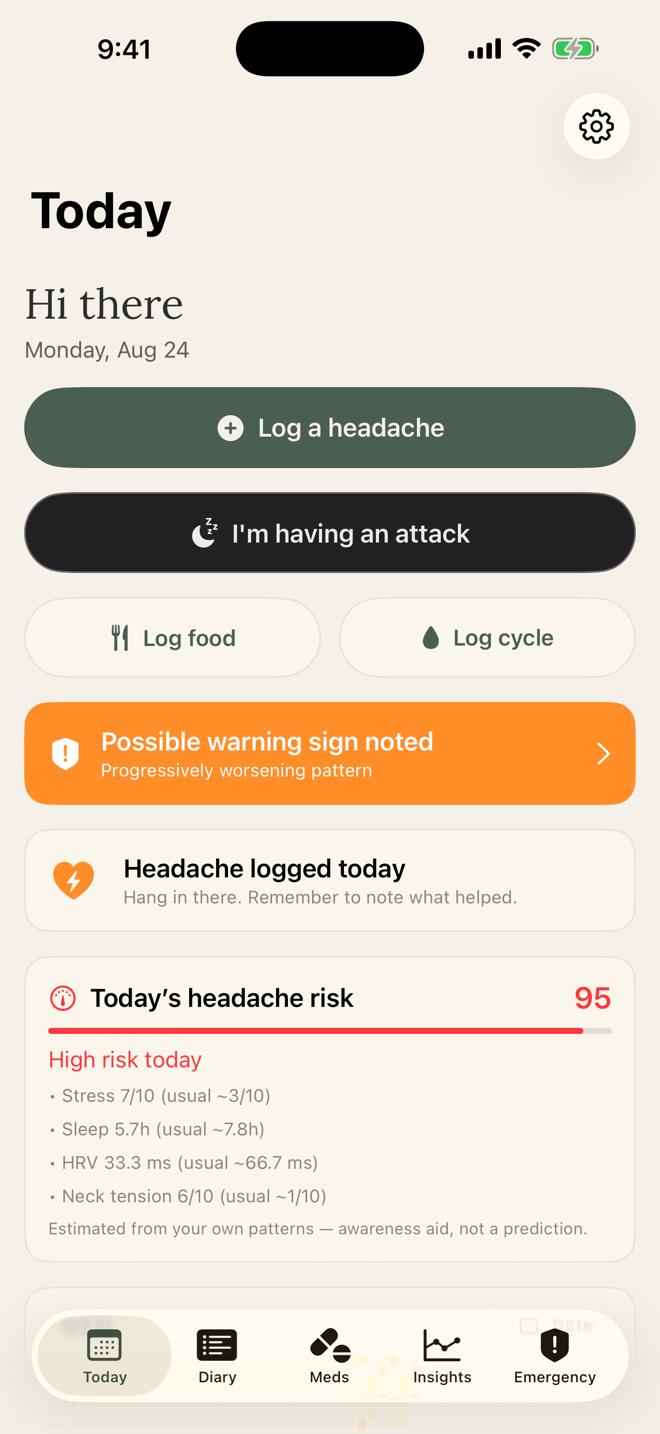
The Today screen: buttons to log a headache or start an attack, a warning-sign notice, and today's risk estimate broken down by contributing factor.
Today
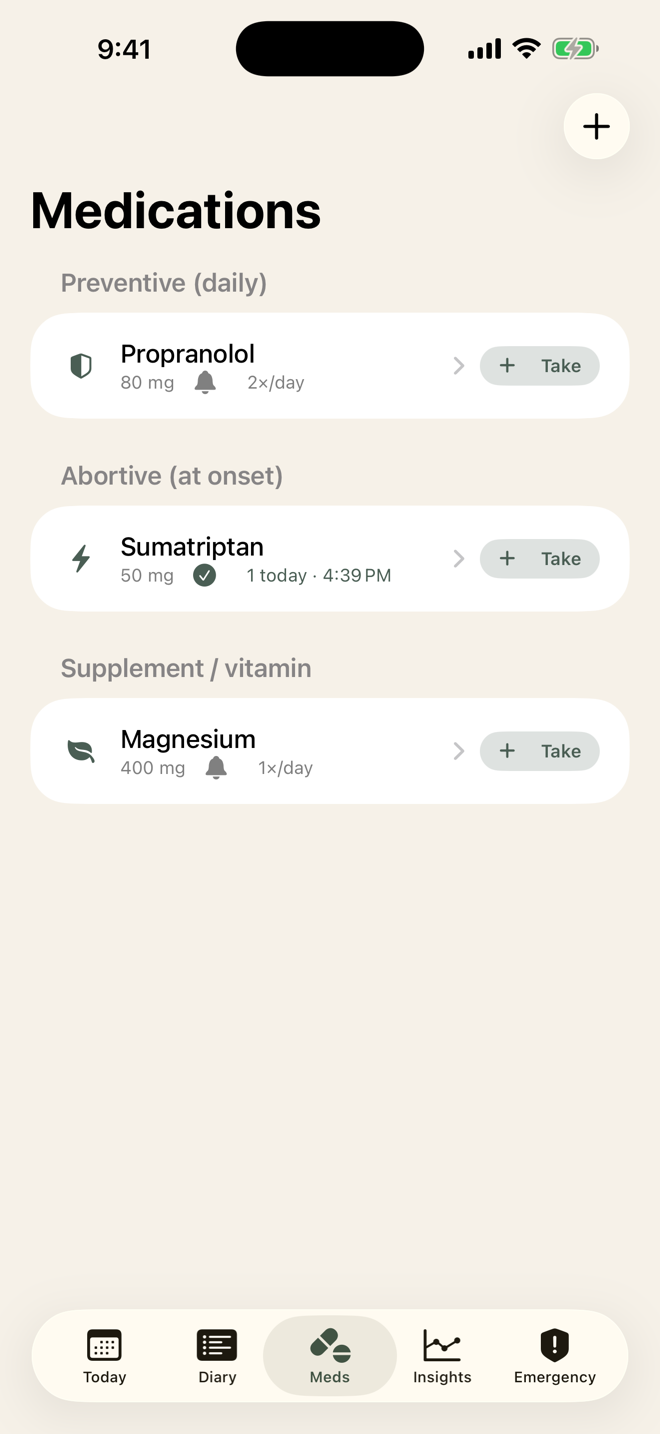
The Medications screen, listing preventive, abortive and supplement medications with doses, reminder schedules and a one-tap Take button.
Medications
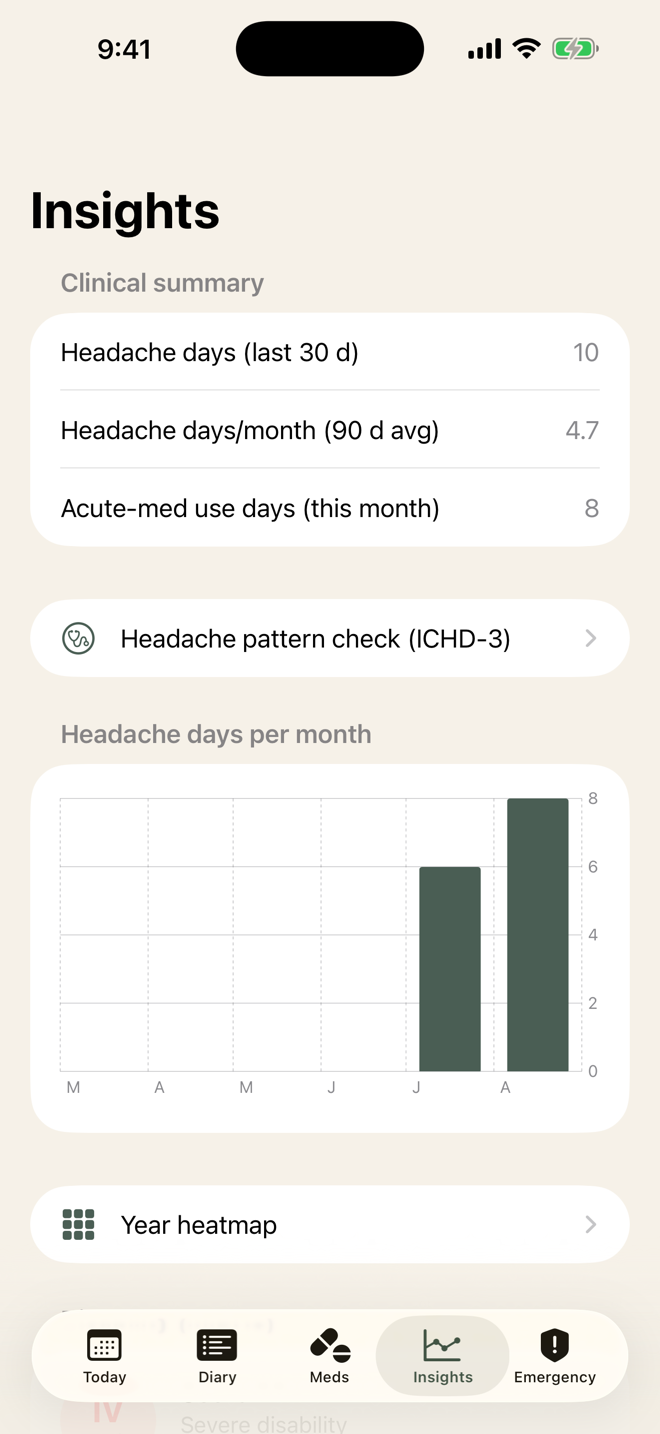
The Insights screen: headache days over the last 30 and 90 days, acute-medication use days, an ICHD-3 pattern check, and a bar chart of headache days per month.
Insights
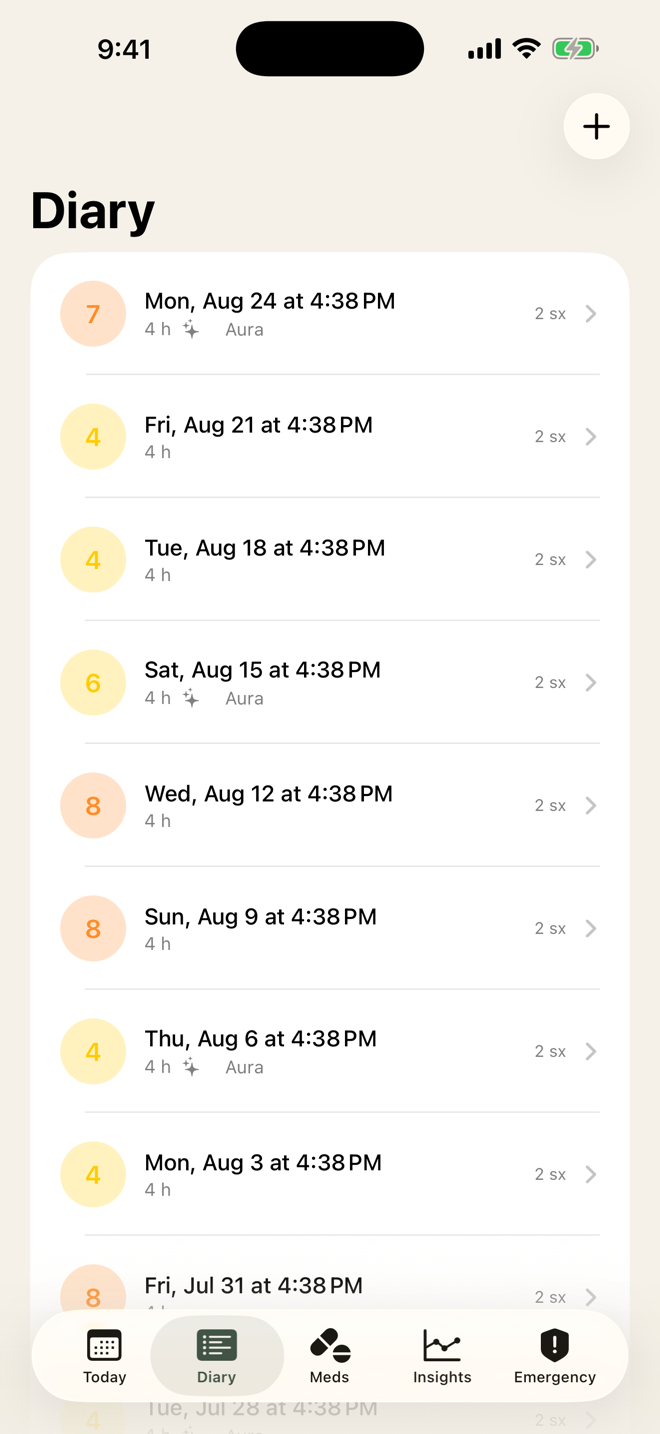
The Diary screen, a reverse-chronological list of logged headache episodes with date, severity and duration.
Diary

Built for bad days

A dimmed, high-contrast attack screen with no animation logs an episode in two taps. Siri can log one hands-free. Add the detail later, when you can look at a screen again.

One page for your neurologist

A PDF with your headache-day trend, a pattern heatmap, medications with overuse flags, possible triggers and your latest MIDAS score. Raw CSV too, for any period you choose.

Medication-overuse thresholds

Days of use are counted against the published monthly limit for each drug class — ten days for triptans, ergots, opioids and combination analgesics, fifteen for simple analgesics and NSAIDs.1,31

Warning signs, by the book

What you log is screened against the SNOOP10 features taught in neurology. These are prompts to seek care sooner, never a verdict, and the app says so plainly.

Patterns, not guesses

Which factors differ between your headache days and your clear days. Whether a preventive actually changed your headache days after you started it. How your logged features line up with ICHD-3 criteria.

Your diary stays yours

There is no account and no server, because there is nothing to send anywhere. Everything lives on your device, or in your own private iCloud. No analytics, no advertising, no tracking.

It is free, in English, Portuguese and Spanish, and it does not diagnose anything. It records what you tell it, shows you the shape of your own data, and gives you something to put in front of a clinician instead of trying to remember.

Download on the App Store Screenshots & details →

Free · iPhone, iOS 17 and later · Privacy · Support

Written by someone who lives it, and is training to treat it.

My name is Seth Mundall. I live with a daily, unremitting headache that meets the criteria for New Daily Persistent Headache. That is the reason this site exists, and the reason I am going into neurology.

NDPH is rare enough that most clinicians will see very few cases, and unfamiliar enough that it is often mistaken for something else first. What I found, looking for information of my own, was a gap: the peer-reviewed literature was there, and the patient-facing material was there, but very little sat in between — accurate about the evidence, and written for the person actually living it. This site is my attempt at that middle ground.

Living with it does not make me an authority on it. It does mean I know which questions go unanswered, because they were mine first.

I came to medicine from software. I have been building things for fourteen years and did not stop when clinical training started — my medical thesis was on prompt engineering and whether large language models can be brought to bear on reading peripheral blood smears, and the apps I have shipped are in daily use. The headache app is that same instinct pointed at my own headache: when the tool you need does not exist, the useful response is to build it carefully and give it away.

Everything here is drawn from published literature and cited as such, and none of it replaces a clinician who knows your history. Where the evidence is thin, the site says so rather than rounding it up — that mattered to me as a patient before it mattered to me as a physician.

Degree
Doctor of Medicine, Universidad Adventista del Plata, Argentina — conferred 2026. A 7-year medical programme, 8 years including the preparatory year, qualifying for general practice in Argentina.
Thesis
Prompt engineering and the application of large language models to the interpretation of peripheral blood smears.
Neurology
Clinical observation in an outpatient neurology practice at Clínica Parque, Crespo, Argentina.
US clinical experience
Five months of clinical rotations at Kettering Health, Dayton, Ohio — internal medicine, general surgery, and obstetrics and gynaecology.
Continuing education
Evidence-Based Approach to the Diagnosis and Management of Migraines in Adults — Stanford Center for Continuing Medical Education.
Languages
Consultations in Spanish and English. Languages are also a hobby — French, and currently Arabic.
Pursuing
Residency training in Neurology in the United States, with the goal of subspecialising in headache medicine.
Built
This site, and Migraine & Headache Companion (on the App Store) — a free headache diary for iPhone with an ICHD-3 pattern comparison, SNOOP10 warning-sign screening, medication-overuse tracking by drug class, and a clinician report, in three languages. Also currently building GrowPal, an infant growth and development tracker built to WHO and CDC standards, co-developed with Licius Santana Kreulich, MD, Thiago Erwin Kreiner, MD, and medical student Fernando Borges, and now on the App Store and Google Play.
In progress
CGRP-targeted therapy in new daily persistent headache, a systematic review and proportional meta-analysis of responder rates, with Fazel Rostamzadeh Bakhtiyari, MD. Registered on PROSPERO (CRD420261493190); protocol frozen on OSF (doi:10.17605/OSF.IO/MKRE5).
Contact
seth@ndph.org — corrections to anything on this site are genuinely welcome.
Full profile →

Away from all of this I play guitar with more enthusiasm than skill, hike when the head allows, and take engines apart on the assumption that they will go back together. I live with my wife and our two children, who are the reason any of this gets finished at a reasonable hour.

Some days the pain wins. Some days you do.

NDPH is one of the most frustrating conditions in headache medicine. The path through it is rarely a single breakthrough. It’s a patient assembly of small advantages — better sleep, fewer inflammatory foods, stronger neck muscles, calmer breath, the right specialist, the right medication eventually.

Stack the small wins. Be kind to yourself on the days you can’t. You did not cause this, and you are not alone in it.

Frequently asked.

What is new daily persistent headache (NDPH)?

A primary headache disorder in which a headache starts on a day the person can usually remember, becomes continuous within 24 hours, and does not let up for more than three months. It is classified as 4.10 in the International Classification of Headache Disorders (ICHD-3).1

How is NDPH diagnosed?

Clinically. A doctor confirms the pattern — a distinct, remembered onset, continuous within 24 hours, present for more than three months — and rules out secondary causes such as a spinal fluid leak, raised pressure inside the head, infection or medication overuse.1 That means an examination and often brain imaging. No blood test or scan can confirm NDPH on its own.

How common is NDPH?

Rare. Population studies estimate that it affects about 0.03% to 0.1% of people — roughly one person in every 1,000 to 3,500.2,3

What causes NDPH?

The cause is unknown, and NDPH is probably several different conditions that share the same sudden start. About half of people link it to a trigger — most often an infection or flu-like illness, then a stressful life event or surgery — and about half cannot identify any trigger at all.4,5

Is NDPH the same as chronic migraine?

No, although they can look alike: about two-thirds of people with NDPH have migraine-like features.7 The difference is how it starts. NDPH is continuous from a day you can remember, while chronic migraine usually builds up gradually from separate attacks. See the side-by-side comparison.

Does NDPH ever go away?

It can. Studies describe some people whose headache persists, some whose headache resolves, and some whose headache comes and goes over the years.39,2 There is not yet a reliable way to predict which course one person will have.

What treatments are used for NDPH?

No treatment has been proven specifically for NDPH. Specialists usually choose preventive treatment according to what the headache looks like — migraine-like or tension-type-like — and the evidence comes mostly from small, uncontrolled studies.7 A headache specialist is the best guide. What has been tried, and the evidence →

When is a headache an emergency?

Seek emergency care for a sudden “worst headache of your life”, a headache with fever and a stiff neck, new weakness, numbness, vision loss or difficulty speaking, a seizure, or a headache after a head injury.

References

Numbers in the text link to these sources. Where the evidence comes from migraine rather than NDPH, the text says so.

  1. Headache Classification Committee of the International Headache Society. The International Classification of Headache Disorders, 3rd edition. Cephalalgia 2018;38(1):1-211. doi.org/10.1177/0333102417738202
  2. Grande RB, Aaseth K, Lundqvist C, Russell MB. Prevalence of new daily persistent headache in the general population. The Akershus study of chronic headache. Cephalalgia 2009;29:1149-55. doi.org/10.1111/j.1468-2982.2009.01842.x
  3. Castillo J, Muñoz P, Guitera V, Pascual J. Epidemiology of chronic daily headache in the general population. Headache 1999;39:190-6. doi.org/10.1046/j.1526-4610.1999.3903190.x
  4. Rozen TD. Triggering events and new daily persistent headache: age and gender differences and insights on pathogenesis — a clinic-based study. Headache 2016;56:164-73. doi.org/10.1111/head.12707
  5. Li D, Rozen TD. The clinical characteristics of new daily persistent headache. Cephalalgia 2002;22:66-9. doi.org/10.1046/j.1468-2982.2002.00326.x
  6. Diaz-Mitoma F, Vanast WJ, Tyrrell DL. Increased frequency of Epstein-Barr virus excretion in patients with new daily persistent headaches. Lancet 1987;1:411-5. doi.org/10.1016/s0140-6736(87)90119-x
  7. Cheema S, Mehta D, Ray JC, Hutton EJ, Matharu MS. New daily persistent headache: a systematic review and meta-analysis. Cephalalgia 2023;43(5):3331024231168089. doi.org/10.1177/03331024231168089
  8. Rozen TD, Beams JL. New daily persistent headache with a thunderclap headache onset and complete response to nimodipine (a new distinct subtype of NDPH). J Headache Pain 2013;14:100. doi.org/10.1186/1129-2377-14-100
  9. Rozen TD, Roth JM, Denenberg N. Cervical spine joint hypermobility: a possible predisposing factor for new daily persistent headache. Cephalalgia 2006;26:1182-5. doi.org/10.1111/j.1468-2982.2006.01187.x
  10. Pringsheim T, Davenport W, Mackie G, et al. Canadian Headache Society guideline for migraine prophylaxis. Can J Neurol Sci 2012;39(2 Suppl 2):S1-59. pubmed.ncbi.nlm.nih.gov/22683887/
  11. Holland S, Silberstein SD, Freitag F, et al. Evidence-based guideline update: NSAIDs and other complementary treatments for episodic migraine prevention in adults. (Retired by the AAN in 2015 over butterbur safety.) Neurology 2012;78:1346-53. doi.org/10.1212/WNL.0b013e3182535d0c
  12. National Center for Complementary and Integrative Health (NIH). Headaches and complementary health approaches: what the science says. Accessed October 2026. www.nccih.nih.gov/health/providers/digest/headaches-and-complementary-health-approaches
  13. Schoenen J, Jacquy J, Lenaerts M. Effectiveness of high-dose riboflavin in migraine prophylaxis: a randomized controlled trial. Neurology 1998;50:466-70. doi.org/10.1212/wnl.50.2.466
  14. Sándor PS, Di Clemente L, Coppola G, et al. Efficacy of coenzyme Q10 in migraine prophylaxis: a randomized controlled trial. Neurology 2005;64:713-5. doi.org/10.1212/01.WNL.0000151975.03598.ED
  15. Sazali S, Badrin S, Norhayati MN, Idris NS. Coenzyme Q10 supplementation for prophylaxis in adult patients with migraine: a meta-analysis. BMJ Open 2021;11:e039358. doi.org/10.1136/bmjopen-2020-039358
  16. Ramsden CE, Zamora D, Faurot KR, et al. Dietary alteration of n-3 and n-6 fatty acids for headache reduction in adults with migraine: randomized controlled trial. BMJ 2021;374:n1448. doi.org/10.1136/bmj.n1448
  17. Maghsoumi-Norouzabad L, Mansoori A, Abed R, Shishehbor F. Effects of omega-3 fatty acids on the frequency, severity, and duration of migraine attacks: a systematic review and meta-analysis of randomized controlled trials. Nutr Neurosci 2018;21:614-23. doi.org/10.1080/1028415X.2017.1344371
  18. Hu C, Fan Y, Wu S, Zou Y, Qu X. Vitamin D supplementation for the treatment of migraine: a meta-analysis of randomized controlled studies. Am J Emerg Med 2021;50:784-8. doi.org/10.1016/j.ajem.2021.07.062
  19. Tirani SA, Khorvash F, Saneei P, et al. Effects of probiotic and vitamin D co-supplementation on clinical symptoms, mental health, and inflammation in adult patients with migraine headache: a randomized, triple-blinded, placebo-controlled trial. BMC Med 2024;22:457. doi.org/10.1186/s12916-024-03684-6
  20. Martami F, Togha M, Seifishahpar M, et al. The effects of a multispecies probiotic supplement on inflammatory markers and episodic and chronic migraine characteristics: a randomized double-blind controlled trial. Cephalalgia 2019;39:841-53. doi.org/10.1177/0333102418820102
  21. Magis D, Ambrosini A, Sándor P, et al. A randomized double-blind placebo-controlled trial of thioctic acid in migraine prophylaxis. Headache 2007;47:52-7. doi.org/10.1111/j.1526-4610.2006.00626.x
  22. Gonçalves AL, Martini Ferreira A, Ribeiro RT, et al. Randomised clinical trial comparing melatonin 3 mg, amitriptyline 25 mg and placebo for migraine prevention. J Neurol Neurosurg Psychiatry 2016;87:1127-32. doi.org/10.1136/jnnp-2016-313458
  23. Alstadhaug KB, Odeh F, Salvesen R, Bekkelund SI. Prophylaxis of migraine with melatonin: a randomized controlled trial. Neurology 2010;75:1527-32. doi.org/10.1212/WNL.0b013e3181f9618c
  24. Wider B, Pittler MH, Ernst E. Feverfew for preventing migraine. Cochrane Database Syst Rev 2015;(4):CD002286. doi.org/10.1002/14651858.CD002286.pub3
  25. Di Lorenzo C, Pinto A, Ienca R, et al. A randomized double-blind, cross-over trial of very low-calorie diet in overweight migraine patients: a possible role for ketones? Nutrients 2019;11:1742. doi.org/10.3390/nu11081742
  26. Jull G, Trott P, Potter H, et al. A randomized controlled trial of exercise and manipulative therapy for cervicogenic headache. Spine 2002;27:1835-43. doi.org/10.1097/00007632-200209010-00004
  27. Wells RE, O'Connell N, Pierce CR, et al. Effectiveness of mindfulness meditation vs headache education for adults with migraine: a randomized clinical trial. JAMA Intern Med 2021;181:317-28. doi.org/10.1001/jamainternmed.2020.7090
  28. Treadwell JR, Tsou AY, Rouse B, et al. Behavioral interventions for migraine prevention: a systematic review and meta-analysis. Headache 2025;65:668-94. doi.org/10.1111/head.14914
  29. Nestoriuc Y, Martin A. Efficacy of biofeedback for migraine: a meta-analysis. Pain 2007;128:111-27. doi.org/10.1016/j.pain.2006.09.007
  30. Hughes LS, Clark J, Colclough JA, Dale E, McMillan D. Acceptance and commitment therapy (ACT) for chronic pain: a systematic review and meta-analyses. Clin J Pain 2017;33:552-68. doi.org/10.1097/AJP.0000000000000425
  31. Diener HC, Dodick D, Evers S, et al. Pathophysiology, prevention, and treatment of medication overuse headache. Lancet Neurol 2019;18:891-902. doi.org/10.1016/S1474-4422(19)30146-2
  32. Robbins MS, Grosberg BM, Napchan U, Crystal SC, Lipton RB. Clinical and prognostic subforms of new daily-persistent headache. Neurology 2010;74:1358-64. doi.org/10.1212/WNL.0b013e3181dad5de